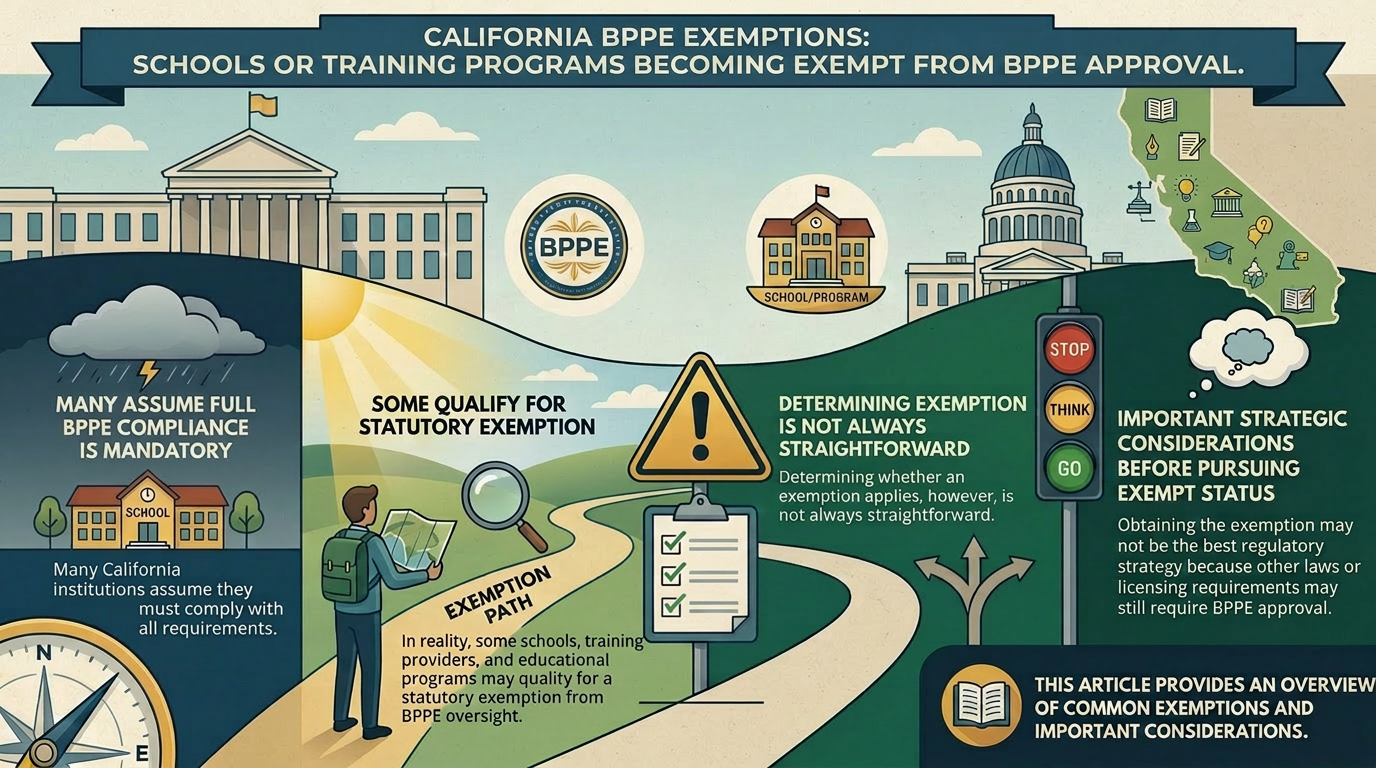
Many California educational institutions assume they must comply with all requirements imposed by the California Bureau for Private Postsecondary Education (“BPPE”). In reality, some schools, training providers, and educational programs may qualify for a statutory exemption from BPPE oversight.
Determining whether an exemption applies, however, is not always straightforward. Even when an institution technically qualifies for a BPPE exemption, obtaining the exemption may not be the best regulatory strategy because other laws or licensing requirements may still require BPPE approval.
This article provides an overview of common BPPE exemptions and important considerations before pursuing exempt status.
What Is the California BPPE?
The California Bureau for Private Postsecondary Education (“BPPE”) is a regulatory agency within the California Department of Consumer Affairs that oversees private colleges, universities, vocational schools, and other private postsecondary educational institutions operating in California.
The BPPE’s primary purpose is consumer protection. To accomplish this goal, the Bureau requires institutions to comply with extensive operational, disclosure, recordkeeping, faculty qualification, student protection, and administrative requirements.
Institutions subject to BPPE oversight may also face:
- Routine compliance reviews
- Announced and unannounced site inspections
- Administrative citations
- Monetary fines and penalties
- Enforcement actions
- Approval-to-operate issues
For many institutions, BPPE compliance represents a significant ongoing operational obligation.
What Does a BPPE Exemption Mean?
A BPPE exemption generally relieves an institution from most BPPE regulatory requirements and oversight.
However, exempt institutions are not entirely free from regulation. Certain obligations may still apply, including requirements relating to student records, transcript retention, and institutional closure procedures.
Because exemptions are highly fact-specific, institutions should carefully evaluate both eligibility and the broader regulatory consequences before seeking exempt status.
Common BPPE Exemptions
Avocational and Recreational Programs
Programs offered solely for personal enrichment, recreation, entertainment, or enjoyment may qualify for exemption. Examples include:
- Dance instruction
- Art classes
- Cooking courses
- Hobby-related workshops
To qualify, the program generally must not be designed to prepare students for employment or professional advancement.
Membership-Based Educational Programs
Institutions that provide educational programs exclusively to members of a bona fide trade, business, professional, or fraternal organization may qualify for exemption. The educational offerings must be limited to the organization’s membership and tied to the organization’s legitimate purposes.
Government-Operated Institutions
Educational institutions established, operated, or governed by the federal government, the State of California, or a political subdivision of California are generally exempt from BPPE oversight.
Test Preparation and Continuing Education Programs
Certain institutions offering admissions test preparation, professional licensing examination preparation, continuing education programs, or professional development training may qualify for exemption if the program is approved, certified, or sponsored by an appropriate governmental agency, licensing authority, or recognized professional organization.
Religious Institutions
An institution owned, controlled, operated, and maintained by a religious organization lawfully operating as a nonprofit religious corporation may qualify for exemption. Because religious exemptions involve highly specific statutory requirements, institutions should carefully evaluate whether all exemption criteria are satisfied.
Low-Cost Educational Programs
An institution may qualify for exemption if:
- It does not award degrees;
- Total program charges are $2,500 or less; and
- No portion of the tuition is paid through federal or state student financial aid programs.
This exemption is frequently misunderstood and should be analyzed carefully before reliance.
ABA-Accredited Law Schools
Law schools accredited by the American Bar Association’s Council of the Section of Legal Education and Admissions to the Bar are exempt from BPPE oversight.
Workforce Development and Rehabilitation Programs
Certain nonprofit public benefit corporations may qualify if they:
- Maintain 501(c)(3) status,
- Are organized specifically for workforce development or rehabilitation services, and
- Hold qualifying accreditation recognized by the California Department of Rehabilitation.
WASC-Accredited Institutions
Institutions accredited by the Accrediting Commission for Senior Colleges and Universities (WSCUC) or the Accrediting Commission for Community and Junior Colleges (ACCJC) may qualify for exemption.
Flight Training Programs
Certain flight instruction providers operating under Federal Aviation Administration (FAA) regulations may qualify for exemption if:
- Students are not required to enter contracts of indebtedness; and
- The provider does not require or accept prepayment exceeding $2,500.
Just Because You Qualify for an Exemption Does Not Mean You Should Seek One
One of the most common mistakes institutions make is assuming that qualifying for a BPPE exemption automatically means obtaining the exemption is the best option. In reality, educational institutions often operate within multiple regulatory frameworks simultaneously.
For example, Emergency Medical Services (EMS) training programs may appear to qualify for a BPPE exemption based on tuition structure or organizational status. However, separate regulations governing EMS programs may require BPPE approval to operate regardless of exemption eligibility. In these situations, obtaining a BPPE exemption could create significant regulatory complications and interfere with program approval requirements imposed by other agencies.
Before pursuing an exemption, institutions should evaluate:
- Whether other agencies require BPPE approval;
- Accreditation requirements;
- Professional licensing requirements;
- Federal and state funding considerations;
- Long-term institutional goals; and
- Future program expansion plans.
Frequently Asked Questions About BPPE Exemptions
Can a nonprofit school automatically claim a BPPE exemption?
No. Nonprofit status alone does not create a BPPE exemption. The institution must satisfy a specific statutory exemption category.
Does a BPPE exemption mean the institution has no compliance obligations?
No. Exempt institutions may still have obligations relating to student records, transcripts, disclosures, and other legal requirements.
Can vocational training programs qualify for a BPPE exemption?
Sometimes. Eligibility depends on the specific program structure, cost, accreditation, licensing requirements, and applicable statutory exemption category.
Should I apply for a BPPE exemption if my institution qualifies?
Not necessarily. Institutions should first evaluate whether other regulatory frameworks require BPPE approval or whether exempt status could negatively affect operations, accreditation, or licensing.
How Shankar Legal Inc. Helps California Educational Institutions
Shankar Legal Inc. regularly advises educational institutions throughout California regarding:
- BPPE exemptions and applications for exemption
- Approval to operate applications
- Compliance audits
- BPPE citations and enforcement actions
- School formation and regulatory strategy
- Accreditation-related compliance issues
- Higher education investigations and regulatory matters
Our approach goes beyond simply determining whether an exemption exists. We help institutions evaluate the broader regulatory landscape to ensure that short-term compliance decisions do not create long-term operational problems.
If your institution is considering a BPPE exemption or evaluating whether BPPE approval is required, contact Shankar Legal Inc. for a regulatory assessment.
Related service: BPPE Regulations