
Quick Takeaway
Primary Insight: A criminal record, past financial trouble, or academic discipline does not automatically disqualify a California bar applicant. What matters most to the Committee of Bar Examiners is full, proactive disclosure and documented rehabilitation, not a clean history.
Key Outcome: Under Business and Professions Code §6060, the State Bar is barred from reviewing an applicant's mental health records unless the applicant chooses to submit them, a protection many applicants don't realize exists.
Best Suited For: Law students and bar applicants with a criminal history, financial issue, prior academic discipline, or other background concern who are preparing to submit a moral character determination application in California.
Passing the bar exam is only part of the requirement for practicing law in California. Every applicant must also clear a moral character determination, and for anyone with a criminal record, a past bankruptcy, academic discipline, or other red flag in their background, that second requirement can feel more uncertain than the exam itself.
The good news is that very few things automatically disqualify an applicant. The State Bar's own guidance is explicit that neither a criminal conviction nor financial trouble bars admission outright. What actually determines the outcome is how the issue is disclosed, documented, and explained, which is exactly where a character and fitness attorney's guidance matters most.
This post walks through what California's good moral character standard actually requires, what tends to trigger extra scrutiny, how rehabilitation gets evaluated, and what the determination timeline looks like.
What "Good Moral Character" Actually Means Under California Law
California requires every bar applicant to be "of good moral character" under Business and Professions Code §6060 et seq.
“Good moral character” includes but is not limited to “qualities of honesty, fairness, candor, trustworthiness, observance of fiduciary responsibility, respect for and obedience to the law, and respect for the rights of others and for the judicial process.” (State Bar Rule 4.40(B)]
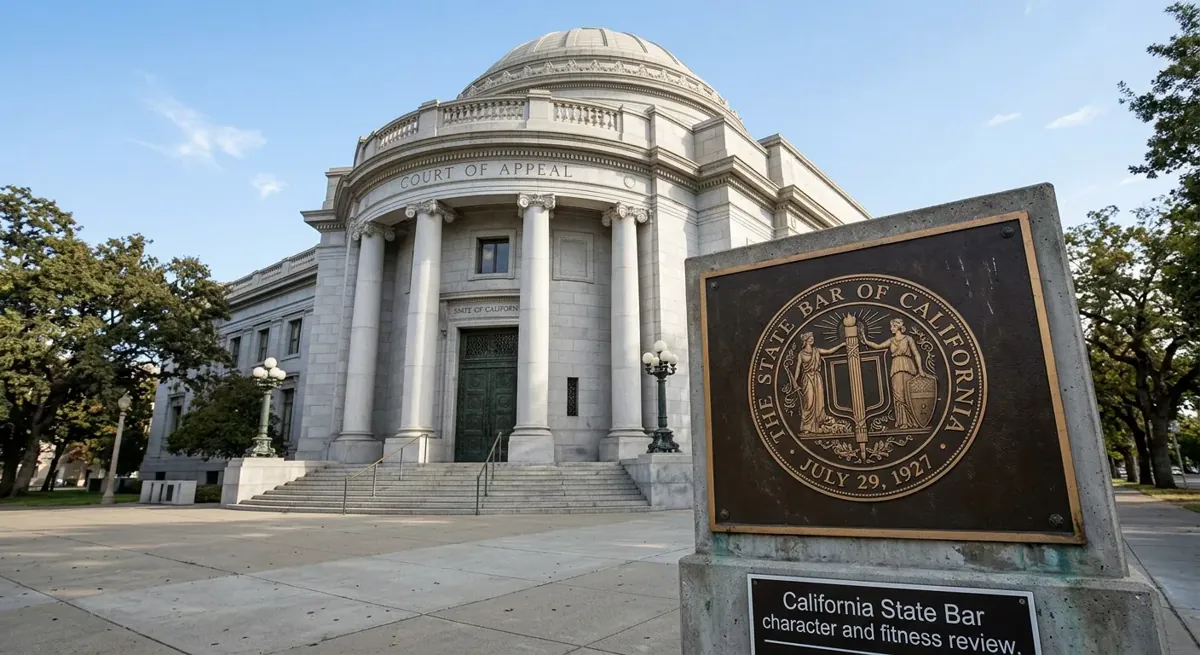
What Triggers Extra Scrutiny in a Moral Character Determination
According to the State Bar's own guidance, several categories of disclosure routinely lead to a closer look including: criminal history, financial delinquency, civil litigation, academic discipline, and employment-related issues. None of these categories result in automatic denial. The State Bar has stated directly that no criminal offense automatically disqualifies an applicant, and that neither indebtedness nor bankruptcy alone prevents admission.
What matters is context: how severe the underlying conduct was, how much time has passed, how often it occurred, and what the applicant has done since. A single, disclosed incident from years ago with clear evidence of change is treated very differently than a pattern of unresolved conduct or one that involved dishonesty. Academic discipline specifically must be disclosed if an applicant was dropped, suspended, warned, placed on disciplinary probation, or expelled from any educational institution, even if the underlying issue seems minor in isolation.
Why Disclosure Matters More Than the Underlying Conduct
This is the point that catches the most applicants off guard: an undisclosed issue is often a bigger problem than the issue itself. The State Bar's guidance is direct that applicants are expected to provide "as much responsive information as possible," and that omissions without explanation can delay or complicate an application well beyond what the underlying conduct alone would have caused.
That expectation covers more than the obvious categories. Applicants must disclose civil actions, administrative matters, and criminal charges, including ones that were later dismissed, along with employment history lasting over six months and residences going back eight years. An applicant who assumes a dismissed charge or a resolved civil matter doesn't need to be mentioned is taking on real risk. Getting the scope of required disclosure right, and framing it accurately the first time, is one of the most valuable things a character and fitness attorney does before an application is ever submitted.
How Rehabilitation Is Actually Evaluated
When past conduct is serious enough to require more than disclosure alone, the Committee of Bar Examiners looks for evidence of rehabilitation.
In re Menna
In re Menna (1995) 11 Cal. 4th 975, a California Supreme Court case, is instructive here because the court laid out what evidence of rehabilitation looks like - and what it does not look like. Joseph Menna (the applicant, “Menna”) was permanently disbarred from the practice of law in New Jersey following his felony convictions for theft of client funds, failure to file a state income tax return, and manufacture of methamphetamine, all stemming from a compulsive gambling addiction that led him to misappropriate nearly $270,000 from clients. After his disbarment, he moved to California, passed the bar examination, and sought admission to the State Bar.
Menna presented substantial evidence in his favor: consistent Gamblers Anonymous participation since 1983, no gambling relapse since 1982, expert testimony from two treating psychologists that he had fully overcome his addiction, and more than 25 character letters and witnesses, including several California attorneys, attesting to his good moral character. Both the Hearing Department and Review Department of the State Bar Court found this sufficient and recommended his admission.
The California Supreme Court disagreed and reversed. It held that because Menna had been disbarred elsewhere, he stood in essentially the same position as a disbarred California attorney seeking reinstatement, and so had to meet a higher "clear and convincing evidence" standard - without the benefit of having doubts resolved in his favor. Applying that standard, the court found the showing insufficient for two main reasons. First, much of his "good conduct" period had occurred while he was in prison, in a halfway house, or on parole, settings where good behavior is expected anyway, leaving only about five and a half years of truly unsupervised good conduct, which the court deemed too short given the severity and duration of his original misconduct. Second, his restitution efforts were minimal: he had made no meaningful payments toward the roughly $220,000 he owed his victims (his former client and law firm), even though his debts had been discharged in bankruptcy rather than actually paid.
The court's language on this point is worth remembering directly: "Remorse does not demonstrate rehabilitation.... [A] truer indication of rehabilitation will be presented if petitioner can demonstrate by his sustained conduct over an extended period of time that he is once again fit to practice law." (Id. at 991). In other words, the person must have taken concrete steps like restitution or community involvement, not just an applicant's own account of having changed, however sincere, and not even character testimony alone, however laudatory.
The Moral Character Determination Timeline
Timing matters more than most applicants expect. The State Bar recommends submitting the Determination Application at the beginning of the last year of law study, or at least 8 to 10 months before the intended admission date. For an application with no complicating issues, the baseline processing time is a minimum of 180 days from when the application is deemed complete.
When a disclosed issue requires closer review, a moral character investigator is assigned, and the applicant may receive a formal request for additional information, with 90 calendar days to respond. The State Bar may also invite the applicant to an informal conference to discuss the concern directly; attending is voluntary, but it's often a meaningful opportunity to address the issue before a final determination is made. Applicants who wait to address a known red flag until late in the process, rather than building their disclosure and supporting documentation early, are the ones most likely to see their timeline extend well past their intended admission date.
Mental Health Records Are Protected
One protection that surprises many applicants: under Business and Professions Code §6060, the State Bar is prohibited from reviewing or considering an applicant's mental health medical records as part of a moral character determination, unless the applicant chooses to submit them to demonstrate good moral character or as mitigation for other conduct.
This matters because concern about mental health disclosure has historically discouraged some law students from seeking treatment during school. California's current law is built specifically to remove that disincentive: mental health history, on its own, isn't something the Committee of Bar Examiners is permitted to go looking for.
Character and Fitness Attorney FAQs
What is a character and fitness attorney and do I need one?
A character and fitness attorney represents bar applicants through the moral character determination process, helping them disclose past issues accurately, present rehabilitation evidence, and respond to any additional inquiries from the Committee of Bar Examiners. Applicants with a straightforward background often don't need one, but anyone with a criminal history, academic discipline, financial issue, or other disclosure concern benefits from guidance before submitting their application, not after a problem arises.
Does a criminal record automatically disqualify me from the California bar?
A criminal record does not automatically disqualify an applicant from California bar admission. The Committee of Bar Examiners evaluates the severity of the conduct, how much time has passed, and evidence of rehabilitation, and has stated directly that no offense results in automatic denial.
When should I submit my moral character determination application?
Applicants should submit their moral character determination application at the beginning of the last year of law study, or at least 8 to 10 months before their intended admission date, since standard processing takes a minimum of 180 days once the application is deemed complete, and longer if additional review is required.
What happens if the Committee of Bar Examiners issues an adverse determination?
An applicant who receives an adverse determination is notified of when they may reapply and can request administrative review by the Committee of Bar Examiners, which may grant approval, request additional information, extend the review period, or issue another adverse determination with a new waiting period.
Can the State Bar consider my mental health history?
The State Bar is generally barred from reviewing an applicant's mental health medical records under Business and Professions Code §6060, unless the applicant chooses to submit them to demonstrate good moral character or as mitigation. Staff cannot request these records on their own initiative.
Building Your Case Before You Apply
The applicants who get through a moral character determination cleanly, even with a real issue in their past, are almost always the ones who disclosed early, disclosed fully, and had documented evidence of the change they were describing. Waiting to address a known concern until the Committee raises it puts an applicant in a defensive position that's much harder to recover from than getting ahead of it from the start.
If you're preparing to submit a moral character determination application and have a criminal history, financial issue, academic discipline, or other background concern you're unsure how to disclose, contact Shankar Legal Inc. before you submit your application, not after the Committee has questions about it.